
Related Guide
Dimensional Variation from Laser Cutting to CNC Bending
Laser cutting and CNC bending each shift dimensions, so a flat blank and a finished formed part rarely measure the same way from one drawing.
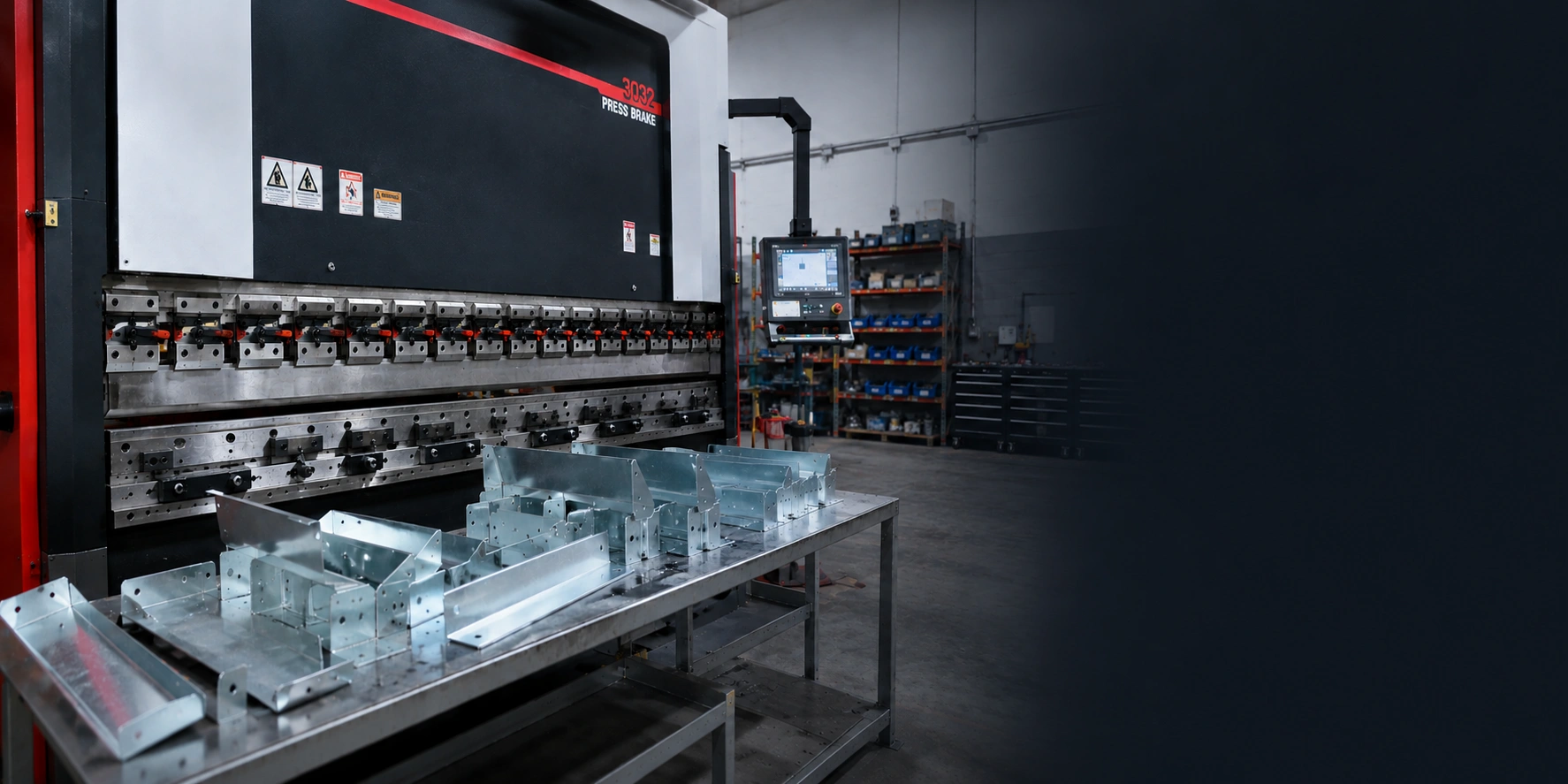
Read articleWhen you are narrowing down a metal fabrication company for an OEM build, the deciding factor is rarely a single process — it is how much of the part stays under one roof. This guide is written for procurement engineers and design leads sourcing custom metal fabrication, and it turns the usual sales claims into a scorecard you can actually apply to a quote: process breadth, tolerance ownership, quality systems, scalability, IP protection and response time.
Before any supplier presentation, agree internally on what a good answer looks like. These seven criteria are the ones most often left vague in a first RFQ round — and the ones that cause rework later.
How many of the required steps are handled in-house rather than subcontracted.
One party accountable for the tolerance chain from first cut to final assembly.
Whether the shop routinely works the material family your part calls for.
Welding certification, inspection discipline and finishing repeatability.
The ability to move from first article to volume without re-sourcing.
How drawings and CAD data are handled once they leave your PLM system.
RFQ turnaround, engineering feedback and production schedule reliability.
The table below pairs each criterion with what the sheet metal fabrication service page actually describes, so you can decide which points need further interrogation and which are already answered.
| Evaluation criterion | Stated capability |
|---|---|
| Process breadth | Laser cutting, precision bending, press forming, custom punching, certified TIG and MIG welding, riveting and fastening, surface finishing, and full product assembly and integration. |
| Tolerance ownership | Laser cutting is positioned for complex contours and tight tolerances; press brakes handle accurate multi-bend parts — the same facility owns the part from first cut through assembly. |
| Material versatility | 304 stainless steel and CNC aluminium appear in the facility's example work; finishing covers powder coating, plating and texturing. |
| Quality system | Certified TIG and MIG welding for seamless, high-strength assemblies, plus grinding, deburring and finishing for a premium, ready-to-assemble look. |
| Scalability | Stated support for low-volume prototyping and high-volume industrial production, with custom parts manufactured to your specifications. |
| IP protection | The facility describes itself as a reliable contract partner that protects your intellectual property while delivering consistent quality. |
| Communication & lead time | A stated lean manufacturing commitment aimed at reducing lead times and optimizing material costs, with a CAD-based estimate route for incoming projects. |

Read down the list and mark every condition that applies to your drawing. Each match tells you which operation must be quoted, and which question to put in your RFQ.
Route the blank through laser cutting before any forming takes place.
Press brake forming for accurate successive bends on the same part.
Structurally demanding parts that need more than a single bend sequence.
High-capacity punching for functional design features in the panel.
Certified TIG and MIG welding for high-strength assemblies.
Integrated riveting and press-fitting for structural stability without thermal deformation.
Grinding, deburring, powder coating, plating and texturing.
Full product assembly and integration rather than loose-part delivery.
Send the same questions to three to five suppliers and score the answers in one grid. Consistent questions are what make the comparison meaningful — a supplier that answers all eight rows has already differentiated itself on communication.
| Comparison row | Supplier A | Supplier B | Supplier C |
|---|---|---|---|
| Cutting, bending and forming coverage | Score 1–5 | Score 1–5 | Score 1–5 |
| Welding certification (TIG / MIG) | Score 1–5 | Score 1–5 | Score 1–5 |
| Finishing options offered | Score 1–5 | Score 1–5 | Score 1–5 |
| Assembly and integration availability | Score 1–5 | Score 1–5 | Score 1–5 |
| Inspection and quality steps described | Score 1–5 | Score 1–5 | Score 1–5 |
| Quoted lead time for your quantity | Score 1–5 | Score 1–5 | Score 1–5 |
| Single point of contact and responsiveness | Score 1–5 | Score 1–5 | Score 1–5 |
| Prototype-to-volume path | Score 1–5 | Score 1–5 | Score 1–5 |
Buyers who arrive with a complete package get a faster, more comparable response. Work through these eight points before your next submission.
Send your CAD and drawings for an estimate, or talk through an OEM/ODM programme, a bulk order schedule or a customization requirement with the team.
the published service list covers laser cutting, precision bending, press forming, custom punching, certified tig and mig welding, riveting and fastening, surface finishing, and full product assembly and integration. confirm during the rfq which of these apply to your specific part.
the service page describes laser cutting for complex contours and tight tolerances and press brakes for accurate multi-bend parts, but it does not list numeric tolerance figures. ask for the tolerance you require to be confirmed in writing against your drawing before the order is placed.
example work on the page references 304 stainless steel and cnc aluminium. finishing options stated include powder coating, plating, texturing, plus grinding and deburring for a ready-to-assemble appearance. always confirm the exact grade and finish for your part.
the facility states support for low-volume prototyping and high-volume industrial production, and describes custom sheet metal parts manufactured to your specifications. ask what changes in tooling, fixturing and inspection as your volume increases.
the facility describes itself as a reliable contract partner that protects your intellectual property while delivering consistent quality. ask for the confidentiality terms that apply before you transmit cad files or production drawings.
prepare drawings, 3d cad, material and finish expectations, tolerance requirements and your quantity plan, then submit them for an estimate. a complete package produces a faster and more comparable quotation.
